The Moment You Stop Filming Is the Moment It Gets Real
The Shot That Ruined the Summit
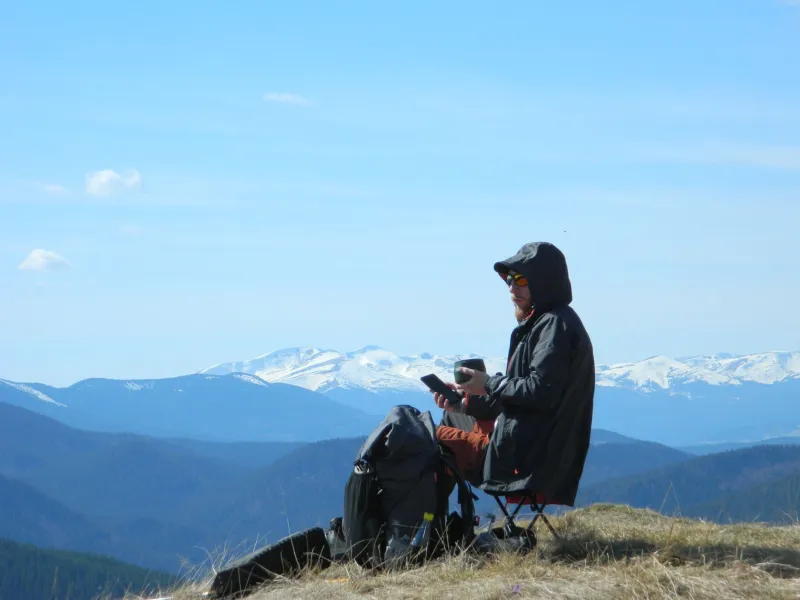
You've been hiking for six hours. Your legs are shot, your water bottle is almost empty, and then — there it is. The ridge opens up and the whole Cascades stretch out in front of you like something you'd only seen in a screensaver. You stand there for about four seconds before your hand moves to your pocket.
Sound familiar?
For a growing number of outdoor adventurers, that reflex — the reach for the phone, the scramble for the right angle, the hunt for signal strong enough to post — has become the defining ritual of modern exploration. And a lot of them are starting to wonder what it's actually costing them.
The tension between living an adventure and broadcasting it isn't new, but it's hit a pressure point. The outdoor recreation economy in the US is booming — Americans spent over $780 billion on outdoor activities in a recent year, according to the Outdoor Industry Association — and social media has been both the engine and the exhaust fume of that growth. More people are going outside. More people are also performing going outside. And increasingly, those two things are pulling in opposite directions.
Why the Best Stuff Doesn't Post Well
Here's the paradox nobody in the algorithm wants to talk about: the experiences that hit hardest almost never make for great content.
Type-2 fun — the miserable-in-the-moment, legendary-in-retrospect kind of adventure — doesn't photograph well. The three-day backcountry slog through Colorado's Weminuche Wilderness where you got rained on every afternoon and your tent footprint filled with water? That's the trip you'll talk about for twenty years. But the photos are gray, blurry, and feature a lot of muddy boots.
Instagram, TikTok, and their algorithmic cousins reward the golden hour summit selfie. They reward the turquoise lake with perfect reflections. They reward the campfire that was lit specifically for the video. What they don't reward — what they structurally can't reward — is the experience that unfolds too slowly, too internally, or too uncomfortably to compress into a reel.
And so, almost without anyone deciding it consciously, adventurers start editing their trips before they even take them. The destination gets chosen for its visual payoff. The route gets planned around viewpoints, not movement. The whole arc of the trip gets shaped, at least partly, by what it might look like to someone scrolling past it at 11pm on a Tuesday.
The Offline Drift
Some people have had enough of that math.
Across the US, a quieter countermovement is picking up steam — adventurers who are deliberately leaving their phones in the car, booking trips to places with no cell service, and making a point of not documenting what they find. Not because they're anti-technology or trying to be precious about it, but because they've noticed something: the trips they remember most vividly are the ones where the camera stayed put.
Talk to anyone who's done a serious multi-week wilderness trip — the Pacific Crest Trail, a Grand Canyon rim-to-rim, a float down the Green River — and you'll hear some version of the same thing. There's a phase, usually around day three or four, where the noise clears. The mental chatter quiets. You stop thinking about what this would look like from the outside and start actually being inside it.
That shift doesn't happen when you're managing a feed.
Research backs this up in interesting ways. Studies on what psychologists call "self-continuity" suggest that memory and identity are strengthened when we fully inhabit experiences rather than mediate them through a lens. When you're focused on capturing a moment, your brain is doing documentation work, not experience work. The two compete. You can optimize for the memory or the post, but doing both at once is harder than it looks.
What You're Actually Chasing
There's a reason people get into adventure travel in the first place, and it's almost never "to have great content." It's to feel something. To be somewhere that doesn't look or feel like the rest of their life. To get genuinely lost, scared, tired, and then — through some combination of grit and luck — find their way back.
That's the jolt. That's what the whole enterprise is actually about.
But when the camera comes out, the experience starts to bifurcate. Part of your brain stays present, sure. But another part floats up and starts narrating, framing, captioning. You become both the explorer and the audience. And the audience part, it turns out, has pretty conservative taste. The audience part wants the beautiful shot, not the ugly honest one. It wants the highlight, not the slog.
Over time, that internal audience can start to steer. And when it does, the adventures get smaller, safer, and more photogenic — even if the miles on the map stay the same.
The Case for Going Dark
None of this is an argument against ever photographing anything outdoors. Wilderness photography has its own rich tradition, and some of the most powerful conservation advocacy in American history has come through images — think Ansel Adams and the fight to protect Yosemite, or the photographs that helped establish Grand Teton National Park.
The question isn't whether to bring a camera. It's whether the camera is running the trip.
A practical middle ground that a lot of seasoned adventurers have landed on: shoot first, post later. Take the photos, but leave them on the device. Don't post until you're home, and don't spend trail time managing comments or checking likes. Some go further and designate entire trips as phone-free, treating the lack of documentation as part of the point.
Others are getting more deliberate about choosing adventures that resist the feed — caving, night hiking, dense forest routes where the light never cooperates, river trips where the water will destroy your phone if you're not careful. Places where the environment itself enforces a certain presence.
The Feed Will Still Be There
Here's the thing about the algorithm: it will wait for you. The platform isn't going anywhere. Your followers will survive a week without a check-in from the backcountry. And honestly? The post you make when you're back, sitting at your kitchen table, trying to explain what it felt like out there — that one might hit harder than anything you could've captured in the moment.
Because the best adventures have a texture that doesn't compress. The cold that got into your sleeping bag at 2am in the Boundary Waters. The weird silence of a Utah slot canyon when the wind drops. The particular quality of light on the Appalachian Trail in late October when everything's gone amber and the ridge drops away forever.
You can try to post that. Or you can just let it live in you, which is where it was always going to end up anyway.
The wild doesn't care about your follower count. It's out there doing its thing regardless. The only question is whether you show up for it — really show up — or spend the whole time trying to prove you were there.