Turn Off the Headlamp: What the Darkness Actually Teaches You Out There
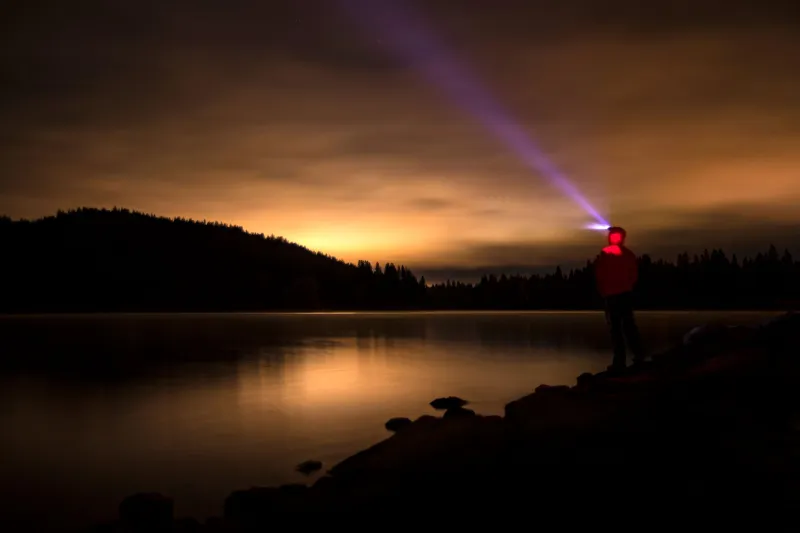
Here's a thing most experienced hikers won't admit until you've known them a while: some of their most transformative trail moments didn't happen at golden hour. They happened at 2 a.m., stumbling through a forest where the only light came from a half-moon filtering through pine branches, when every sense they had was working overtime just to stay upright.
Night hiking is having a quiet moment in the outdoor community. Not a loud, Instagram-friendly moment — which is kind of the point. The people drawn to it aren't chasing content. They're chasing something harder to name.
Your Brain on Darkness
When you remove the dominant sense most humans rely on — vision — everything else gets louder. And that's not a metaphor. Research on sensory compensation consistently shows that when visual input drops, the brain allocates more processing power to auditory and tactile signals. On a night hike, you're not just walking differently. You're thinking differently.
"Daytime hiking, especially on popular trails, has a lot of performance baked into it," says Marcus Delray, a wilderness guide based out of Asheville, North Carolina, who leads monthly night navigation courses through the Pisgah National Forest. "People are aware of being seen. They're thinking about their pace, their gear, how they look taking a break. At night, all of that falls away completely. Nobody's watching. You stop performing and start actually being somewhere."
That shift — from performance to presence — is something night hikers describe over and over again. It's not mystical. It's neurological. The brain stops scanning for social cues and redirects its attention to survival-level inputs: the crunch underfoot, the temperature change near a creek, the sound of something moving twenty feet to the left in the brush.
The Fear Factor Is the Feature, Not the Bug
Let's be honest about something. Night hiking is a little scary. Not necessarily dangerous — we'll get to that — but genuinely, primally unsettling in a way that most modern experiences simply aren't.
And that's exactly why it works.
"There's a difference between manufactured fear — like a haunted house or a horror movie — and the real low-level anxiety of being in a wild place after dark," explains outdoor psychologist and avid night trekker Dana Osei, who has studied risk perception among adventure athletes. "The manufactured stuff gives you a spike and then it's over. What happens on a night trail is more sustained. Your nervous system stays engaged. And when you come out the other side of that, having navigated it, the sense of competence you feel is genuinely profound."
This is the paradox the night hike presents: the thing that makes it intimidating is the same thing that makes it rewarding. You can't separate them. The darkness is the point.
For many adventurers, especially those who've felt the creeping sense that their outdoor experiences have become routine — same trails, same views, same filtered photos — night hiking delivers something that's genuinely hard to replicate. It resets your relationship with familiar terrain entirely.
Known Trails, Unknown Territory
One of the most disorienting and ultimately exhilarating aspects of night hiking is what it does to places you think you already know. A trail you've walked twenty times in daylight becomes almost unrecognizable after dark. Landmarks disappear. Distances feel different. The whole spatial map your brain built through repeated visits gets scrambled.
Jordan Whitfield, a trail runner from Colorado who began incorporating night runs into her training two years ago, describes hiking a section of the Colorado Trail she'd covered dozens of times. "I knew every switchback. Or I thought I did. At night, I was completely present in a way I hadn't been in years on that stretch. I had to actually pay attention. It was like doing it for the first time, but with the confidence of someone who'd done it before. That combination is kind of incredible."
This is where night hiking earns its reputation as a genuine skill-builder rather than just a novelty. Navigation by feel, by sound, by memory — these are muscles that atrophy fast in the age of GPS and well-marked trails. The dark forces you to use them again.
Practical Realities: This Isn't a Vibe, It's a Skill
None of this is an argument for wandering into the woods unprepared and hoping darkness becomes your guru. Night hiking demands a specific kind of readiness that goes beyond throwing a headlamp in your pack.
Delray's first rule for night navigation beginners is counterintuitive: learn the trail in daylight first. Multiple times. "You want to be surprised by the experience of being out there at night, not by the terrain," he says. "If you're figuring out where the trail goes while also managing your fear response in the dark, you've stacked too many variables."
Beyond familiarity, the essentials shift. A quality headlamp with a red-light mode (which preserves night vision far better than white light) is non-negotiable. So is telling someone your exact route and expected return time. Wildlife behavior changes at night — you're more likely to encounter animals that are actually active, from deer to, depending on your region, larger predators. Knowing what's native to your area and how to respond matters.
Temperature drops faster than most daylight hikers account for. Moisture increases near dawn. The margin for error shrinks in ways that are less forgiving than a midday outing where you can simply turn around and see where you came from.
What the Night Shows You That Daylight Buries
Ask anyone who's been doing this a while what night hiking actually reveals, and the answers get surprisingly consistent. Bioluminescent fungi on rotting logs that you'd walk right past in daylight. The way sound travels differently across water in still air. The exact moment before dawn when birds begin — not all at once, but in a specific sequence that you'd never have the patience to notice with your phone in your pocket and the sun already up.
There's also something it reveals about you specifically. How you handle uncertainty. Whether your instinct is to freeze or to move slowly forward. What your internal voice sounds like when there's nothing external competing with it.
"People come on these night hikes thinking they're going to learn about navigation or wildlife or the forest," Delray says. "And they do. But mostly they learn about themselves. That's the thing nobody puts on the flyer."
The trail at midnight isn't hiding something from you. It's just waiting for you to show up without all the noise. Most of us never do.
Maybe that's the real reason to go.