Chasing Bigger and Feeling Less: The Brain Science Behind Adventure Burnout
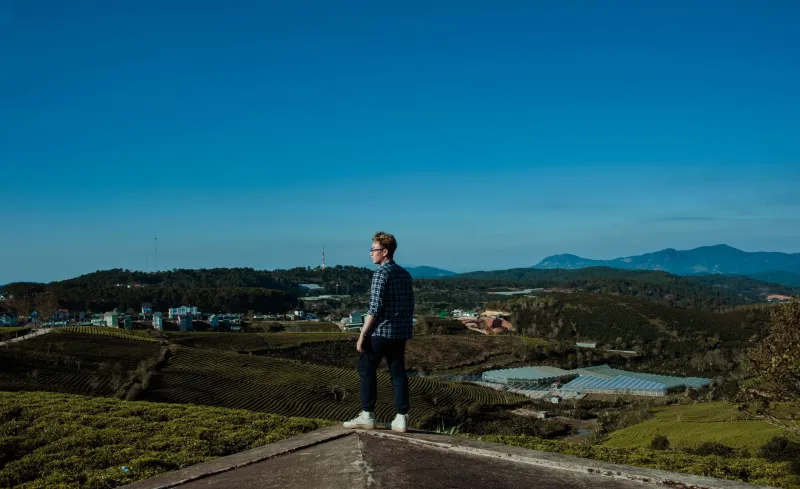
There's a moment that catches a lot of serious adventurers completely off guard. You're standing somewhere objectively incredible — maybe the rim of a volcano, maybe the far end of a multi-week backcountry traverse — and instead of the electric, full-body rush you expected, you feel something closer to... fine. Not bad. Just fine. Like you've been here before, even when you haven't.
If that sounds familiar, you're not broken. You're not ungrateful. You're experiencing one of the most well-documented quirks of human neurology, and it has a name: hedonic adaptation. And for the adventure-obsessed, it's quietly one of the most disorienting forces you'll ever face.
Your Brain Is Working Against You (Kind Of)
Here's the basic mechanic. Every time you experience something thrilling — a first rappel, your first Class V rapid, your first summit above 14,000 feet — your brain floods with dopamine. That chemical surge is the sensation you're chasing. The problem is, your brain is an extraordinarily efficient machine. It calibrates. It normalizes. What once required a 200-foot waterfall to trigger now barely registers a blip.
Dr. Melissa Hartley, a behavioral psychologist who works with high-performance athletes in Colorado, puts it plainly: "The brain doesn't reward the experience itself. It rewards the novelty of the experience. Once something stops being new, the reward signal weakens — sometimes dramatically. That's not weakness. That's biology."
For adventurers, this creates a specific trap. The natural response to a flattening experience is escalation. Bigger mountain. Longer route. More technical terrain. More remote. More dangerous. Each escalation delivers a temporary spike, which then flattens again, which demands another escalation. Rinse, repeat — until the stakes get genuinely unsustainable.
The Escalation Ladder Has a Ceiling
Speak with enough veteran adventurers and a pattern emerges. Ryan Castellano, a 41-year-old climber from Flagstaff who has spent two decades working his way up increasingly serious objectives, describes a turning point after completing a major Alaskan route he'd chased for years.
"I expected this massive release," he says. "I'd wanted that climb for so long. And when we topped out, I remember thinking — okay, what's next? Not in an excited way. In a kind of hollow way. That scared me more than anything on the mountain did."
That hollowness has a clinical analog. Researchers studying sensation-seeking behavior — a personality trait that psychologists have been measuring since the 1960s — consistently find that high sensation-seekers are particularly vulnerable to the diminishing returns cycle. The same neurological wiring that draws people toward risk and novelty makes them especially susceptible to habituation.
The ceiling isn't just psychological, either. There's a physical reality: the adventure escalation ladder eventually runs out of rungs. You can only go so high, so fast, so far into the wilderness before the margin for error disappears entirely.
What You're Actually Chasing
Here's where the conversation gets interesting — and genuinely useful. Because the problem isn't adventure itself. The problem is a misidentification of what made the early adventures so powerful.
Most people, when they think back on their most meaningful outdoor experiences, aren't actually describing the objective difficulty. They're describing connection. Presence. Surprise. The afternoon everything went sideways and the group had to improvise. The moment the fog lifted and the valley appeared. The campfire conversation that lasted until 2 a.m. The time they were genuinely, completely uncertain of what came next.
"Difficulty is just one delivery mechanism for those feelings," says Dr. Hartley. "And it's a delivery mechanism with diminishing efficiency over time. But novelty — genuine novelty, which doesn't have to mean danger — can be renewable."
This reframe is something a growing number of experienced adventurers are landing on, often after years of chasing harder and feeling less.
The Case for Going Sideways Instead of Up
Jamie Okafor, a former ultramarathon competitor from Portland who has since pivoted toward packrafting, canyoneering, and multi-discipline wilderness travel, describes her evolution this way: "I kept running longer distances and feeling less. Then I ran a weird, scrappy little river canyon in eastern Oregon with a friend who knew the drainage. We were problem-solving all day. I felt more alive on that trip than I had in years of racing."
What Okafor stumbled into is something researchers call "lateral novelty" — expanding the type of experience rather than the intensity. A seasoned hiker who picks up sea kayaking isn't just learning a new skill; they're resetting their baseline. The brain treats genuine unfamiliarity as novelty regardless of whether the objective danger is higher or lower.
The same logic applies to geography. Plenty of American adventurers have spent years chasing iconic destinations — Yosemite, the Grand Canyon, the Cascades — while entire regions of the country sit largely unexplored. The sandstone wilderness of southern Utah's lesser-known drainages. The swampy, labyrinthine backcountry of the Southeast. The volcanic tablelands of the high desert. These places don't require escalation. They require curiosity.
Slowing Down as a Radical Act
There's another variable that rarely gets discussed in adventure circles: pace. The rush to accumulate experiences — to tick objectives, to keep the feed populated, to stay ahead of the curve — is itself a form of adaptation acceleration. The faster you burn through experiences, the faster you normalize them.
Some of the most satisfied long-term adventurers describe a deliberate deceleration. Spending more time in fewer places. Returning to the same canyon in different seasons. Learning the specific ecology of a single mountain range instead of collecting summits across a dozen ranges. This isn't retreat. It's depth over breadth, and it turns out depth is far more resistant to hedonic adaptation.
"Mastery creates its own sustained reward," Dr. Hartley explains. "When you go deep into something — really deep — the learning curve stays steep for a long time. And that sustained learning keeps the brain engaged in a way that pure novelty-seeking can't maintain."
The Long Game
None of this means you should stop pushing your limits. Ambitious objectives, hard routes, and genuine physical challenge are legitimate and valuable parts of an adventurous life. But treating escalation as the only lever — assuming that bigger always means better, that the plateau can be outrun indefinitely — is a losing strategy.
The adventurers who seem to sustain genuine fulfillment over decades share a few things in common. They diversify their experiences laterally, not just vertically. They invest in community and shared experience as much as solo achievement. They stay curious about places and disciplines they haven't mastered yet. And they've made a kind of peace with the plateau — recognizing it not as failure, but as a signal to explore differently.
The jolt you're looking for is still out there. It might just be waiting somewhere you haven't thought to look yet.